For a step-by-step workflow, read Review context before changing engines. For current provider support, consult Capabilities; this chapter describes reviewed surfaces and their limits.
Provider history
History reads the supported agent's session archive for the project/account. A folder rename can orphan path-keyed archives unless they are migrated. Check identity and working directory before concluding that a conversation was lost.
Boundary and recovery: Consult the provider capability table for read/resume differences. Unsupported history should be reported as unavailable, not silently treated as an empty conversation.
Inspect one named account's history
Replace PROJECT with the exact registered project and DEMO_ACCOUNT with an existing named Codex account. Select a provider/account before interpreting an empty archive.
Read-only inspection.
commandem sessions PROJECT --agent codex --account DEMO_ACCOUNT --jsonExpected result: A provider-qualified session listing for that project/account. Unsupported adapters, missing accounts and unreadable archives are errors or unavailable states, not proof that no conversation occurred.
Native resume versus bridge
Native resume continues a source-provider session under its owning account. A cross-provider bridge transfers reviewed evidence into a different conversation; it does not grant the destination ownership of the native transcript.
Extra chat tabs begin fresh. In an empty extra chat, Resume latest checks the selected provider/account’s project history. It reports a missing or already-open latest session rather than silently selecting an older one. Confirm the destination identity before sending.
Boundary and recovery: Changing provider or account may require a bridge. Start clean means no bridged payload; a stale or mismatched preview must be reviewed again.
- Match identity
Check project, provider, account and source session.
- Choose the path
Resume an owned native session, or preview evidence for a different conversation.
- Review before sending
Approve a current bridge, or choose Start clean to transfer no payload.
Context inspector and manifest
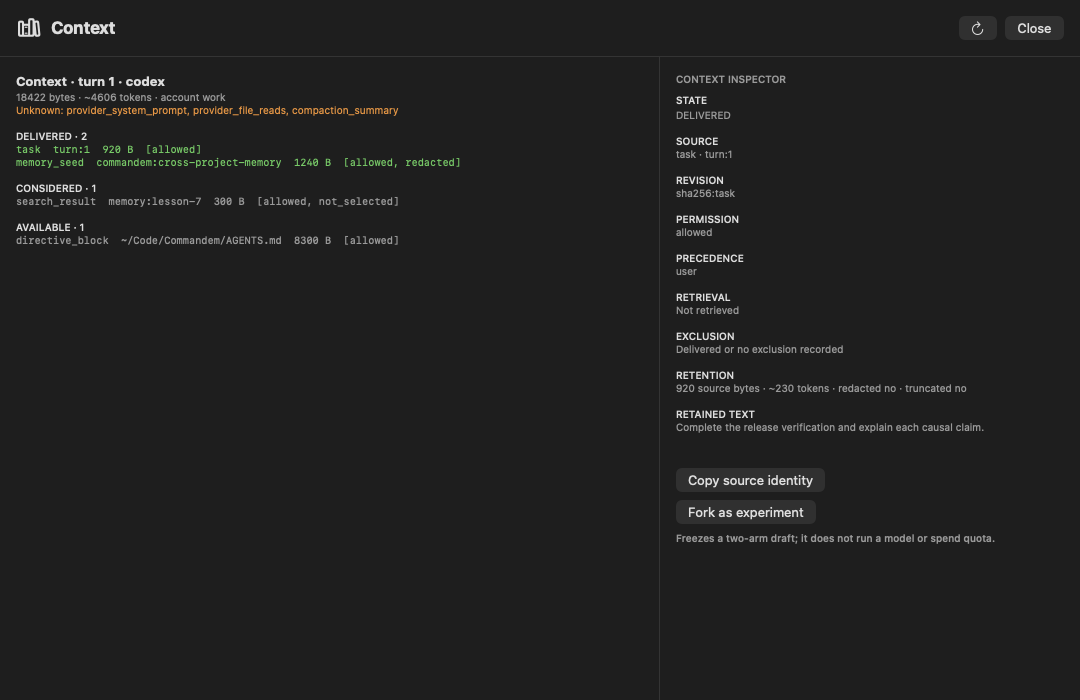
Inspect which sources were selected, included, excluded or truncated in a context manifest. Source identity, revision, privacy provenance and payload accounting explain what the destination could receive.
Availability, selection and delivery are different evidence states. Matrix counts a file reference as delivered context only when its entry is marked delivered, allowed and without an exclusion. Discoverable project guidance remains availability evidence. Even recorded delivery does not prove that the provider read, edited or successfully used the file.
Boundary and recovery: A token estimate is an estimate. A manifest is not a model's attention trace and cannot prove how a model used the supplied information.
Inspect one request boundary
Replace RUN_ID with a recorded run or session that has a captured manifest. The positional 1 selects turn one; choose a real positive turn number for the record you are inspecting.
Read-only inspection.
commandem context-inspect RUN_ID 1Expected result: The stored manifest as JSON, including known selections, exclusions and accounting. No manifest is an explicit error. This does not rerun the turn or prove which supplied facts influenced the model.
Reviewed handoff
Select candidate evidence, inspect the preview, remove irrelevant material and approve a current handoff. The transition contract binds plan, preview, review and current state to the payload and manifest draft.
Boundary and recovery: Redaction precedes truncation. Credentials and untrusted instructions must not become authority; changed evidence invalidates the earlier review.
Matrix labeling and learned models
Human labels judge whether two conversations share useful objectives or evidence, not whether their wording looks similar. Related pairs should help continue actual work; insufficient evidence can be skipped. Cross-provider examples need deliberate coverage.
Boundary and recovery: A labeling queue is not an active trained model. See Matrix workspace scope and dated research evidence. Offline research qualification uses human judgments, topology coverage and held-out evaluation. Those checks do not complete the separate ordinary-use learning and online promotion loop, which is not yet implemented end to end. Do not imply that deterministic Matrix is a GNN.
Live learned scoring accepts only the current model schema and feature revision, the expected finite weights and a usable version identifier. Loading an incompatible active artifact reports an error; applying it leaves deterministic scores unchanged. These checks establish compatibility, not model quality. An older cached graph cannot establish which model is currently admissible.
Fresh Matrix graph JSON records the similarity scorer revision, callback attempts, usable embeddings and actual cosine or lexical pair counts. An unavailable or malformed embedding affects only pairs involving that item; mismatched dimensions fall back for that pair. Failure causes are content-free, and unverified backend or model identity stays unknown. Callback attempts may be cache hits, not provider requests. Older cached graphs can lack this record; reading a cache does not rescore it or train a model.
Graph snapshots with incompatible file-evidence semantics are not reused. Cached graph inspection can reconstruct from retained inventory without scanning provider transcripts; a transition preview may instead ask you to refresh Matrix. Refreshing the graph does not train or activate a model.
Causal investigation and memory
Replay, context provenance and project memory help reconstruct trigger, evidence, mechanism, change and measured effect. Use source-backed links and state confidence explicitly when recording a lesson.
Boundary and recovery: Sequence alone is not causation. Unknown mechanisms should prompt instrumentation or a controlled test, not an unverified fix presented as proven.
Find a prior objective without resuming it
This searches registered conversation archives. The query is an example, not a project selector. The --since flag uses a Go duration; --max limits matching turns per session, not the number of sessions searched.
Inspection with possible local summary-cache writes.
commandem chatsearch --role user --since 168h --max 5 "acceptance criteria"Expected result: Ranked, bounded matches with provider/session/project provenance. Inspect the source before treating a snippet as a current decision; no chat resumes and no model is invoked. Reading Claude archives can refresh local transcript-summary sidecars. Source transcripts are not edited, and this form makes no provider request.
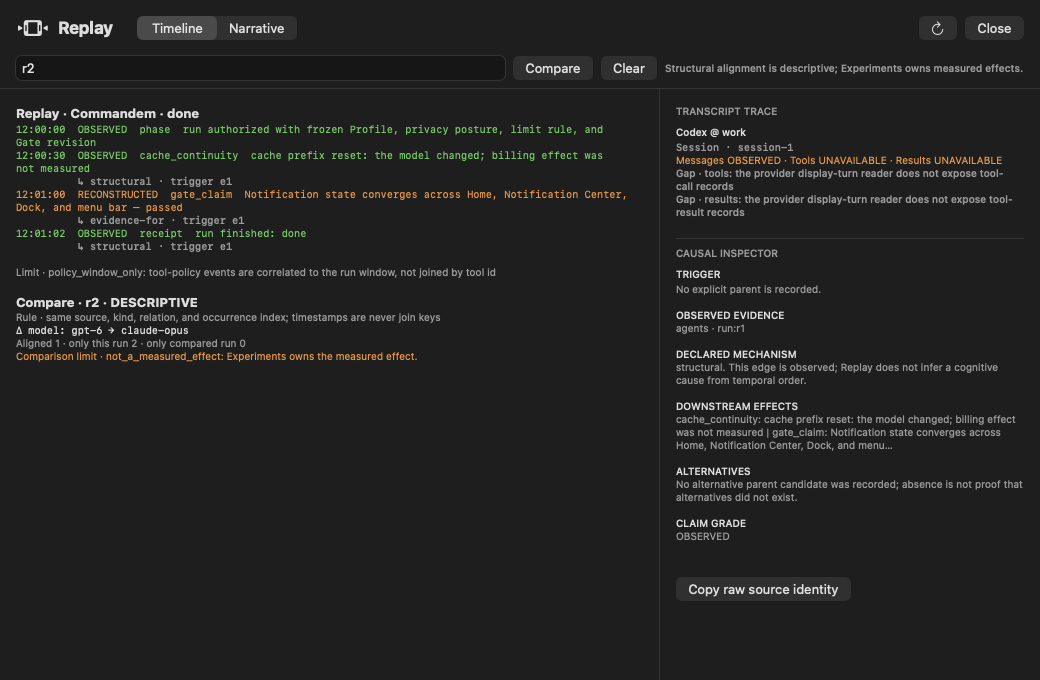
Replay inspection and run receipts complement the context manifest. They answer different questions.